
As a family physician, you serve as the first port of call for patients of all ages, whether they arrive for a routine check-up, a persistent cough, or a new onset of heart or lung symptoms. Your diagnostic time is limited, but your patients’ expectations are high. You need tools that help you detect subtle signs early, communicate findings clearly, and act with confidence. That’s precisely why VoqX can transform your practice.
Traditional acoustic stethoscopes remain a symbol of clinical care, but they face inherent limitations, especially when you must pick up faint lung crackles, early interstitial processes, or subtle extra-heart sounds.
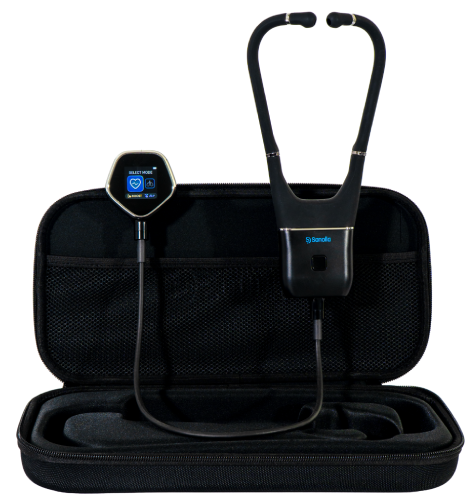
With VoqX, Sanolla has taken a leap forward in auscultation technology by incorporating infrasound capabilities (sound below the range of human hearing) and an on-board display that shows waveforms, phonocardiograms and spectrographs of the sounds picked up. That means that in a busy outpatient clinic you are not only hearing what you auscultate, you’re also seeing it.
Impact on everyday practice
Imagine a patient walking in with a cough and mild shortness of breath. The differential spans upper respiratory infection, bronchitis, pneumonia, maybe early heart failure or a COPD flare. With a standard stethoscope, you might detect wheezes or auscultatory crackles, but you might miss very subtle fine crackles, which could herald pneumonia or interstitial change. With VoqX, you are equipped to pick up lower-frequency infrasound signals and display them visually for confirmation and patient communication.
While physicians typically detect pneumonia with stethoscopes at about 50-60 percent accuracy, VoqX has achieved detection rates of 85-95%. That means you can act sooner. You can decide whether to order imaging, refer to a pulmonologist, or safely manage in the clinic with more confidence. You can explain to a worried parent that you not only heard crackles but could view the signature on the display.
“With Voqx, the lungs sound very clear (like crackles), and I can see the waveforms in the stethoscope as well. I like the ability to hear subtle sounds like S3 and-S4. It is easy to use, and I can also use device during OPD consultations,” says Dr. Mordechai Alpern, Head of Family Medicine at Clalit Health Services.
Optimized family practice
In the U.S. primary care setting, you often don’t have immediate access to advanced imaging or specialist support. Your diagnostic arsenal must be compact, efficient and integrated into your workflow. VoqX is built for that environment: it mimics the form and feel of a traditional stethoscope but adds a digital layer.
By using this smart stethoscope, you can position yourself as offering enhanced diagnostics in the primary-care setting. That increases patient satisfaction, supports your practice differentiation.
The U.S. primary-care landscape is evolving remote monitoring, telehealth, chronic-disease management and value-based reimbursement are all accelerating. While VoqX is currently deployed in clinic, its architecture, built for AI-support and full-spectrum auscultation, positions your practice for future upgrades and integrations. For instance, recordings could be shared with specialists, used in teleconsultations, or stored for longitudinal tracking of chronic conditions.